
Speaker Lab
Biohacking Village Speaker Lab — presentations and talks from the world's top healthcare cybersecurity researchers at DEF CON.
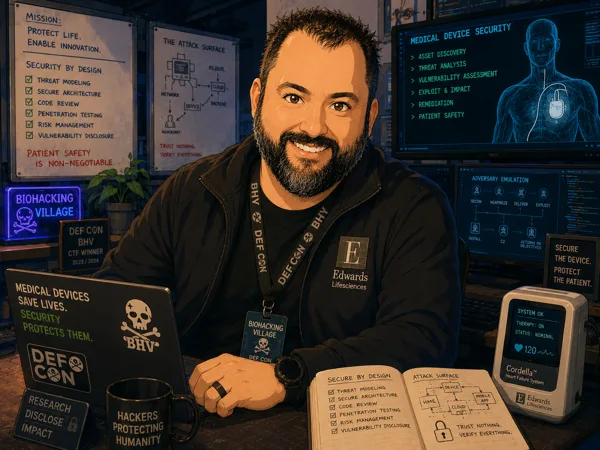 Led by Jay Radcliffe
"The Speaker Lab fosters critical thinking, problem solving, interaction, literacy skills, ethics, creativity, discussion, and collaboration."
Subject matter experts and researchers share lived experiences and reflect the dynamic changes in the ecosystem.
As end users of the medical system, we have an opportunity to change the dynamic of our industry, particularly in reflecting on the momentum of the current situation we have faced as a worldwide community during COVID-19. We work to enlighten and inspire BHV attendees through creative and collaborative discussions around emerging technologies and threats, novel work in biologics, security architectures, and the opportunities inside the interdisciplinary nature of healthcare.
"Reimagine and reinvent healthcare through action, equity, and trust."
What We Look For in Talks
Significance
Does your project deliver meaningful impact to the biohacking scientific community? Does it add value — scientifically, technologically, ethically, or culturally?
Originality
Is your project an original work, or does it sufficiently build upon current research in a unique and meaningful way? Are your methods producing stronger results?
Scientific Rigor
Was the project conducted in accordance with the scientific method and ethics standards? Are less-scientific aspects acknowledged?
Coolness Factor
Extra points for the 'cool' factor. We want to be wowed, to have our jaws drop in wonder. Amaze us with what you've made reality.
2026 Talks & Panels
Counting the Dead in the Digital Siege: Detection Infrastructure for Cyber-Mapping Patient Harm
Jorge Acevedo Canabal, MD; Scott Shackelford, JD, Szymon Skalski, M,LLM
Ransomware Kills Patients. We Can't Prove It. Here's How We Fix That. Ransomware attacks on hospitals kill people. That's not a hypothesis — it's in the data. A peer-reviewed analysis of Medicare claims (American Economic Journal: Economic Policy, 2026) puts in-hospital mortality at 34 to 38 percent higher during attacks. The dead are disproportionately elderly, critically ill, and patients of color. Dameff et al. (2023) documented emergency department spillover. Neprash, Dameff, and Tully (2024) traced the same pattern through the Change Healthcare attack. The mechanism isn't exotic. Encrypted EHRs mean clinicians are flying blind — no medication history, no imaging, no labs. Networked infusion pumps, ventilators, and monitors drop to manual. Ambulances get diverted, stacking patients at facilities that weren't hit. In rural areas, transfer times go from nine minutes to thirty-three. Here's the deeper problem: these deaths are architecturally invisible. No ICD code exists for "died because the hospital's network was encrypted." No death certificate asks whether the hospital was under cyberattack. No public health surveillance system captures excess mortality from clinical failure caused by ransomware. Mandatory reporting requirements attach to data breach — not patient harm. Voluntary harm-reporting channels exist, but they're anonymous and sporadic. The visible signal is a fraction of what's actually happening. This isn't a technical gap. It's a design failure in the detection infrastructure itself. This talk makes the case for cyber-harm epidemiology. Using a forthcoming law review article, we show that existing systems — ICD external-cause coding, NCHS disaster-death certification, SNOMED CT alignment, the Sendai Framework's Hazard Information Profiles (2025) and Global Disaster-Related Statistics Framework (2026) — can be adapted right now to make cyber-attributable patient deaths visible at population scale. No new treaties required. Better detection produces better attribution. Better attribution makes state obligations under the right to life and the protection of medical units enforceable — not aspirational. The deaths are real. The tools to count them exist. We just haven't connected them yet. That's what this talk is about.
Jorge Acevedo Canabal, MD (University of Puerto Rico School of Medicine, Magna Cum Laude), is a physician and Visiting Scholar at the Ostrom Workshop, Indiana University, working on research that sits at the intersection of healthcare, public health, and cybersecurity, applying epidemiological and disaster medicine methods to map patient harm attributable to healthcare cyberattacks and technological hazards. He previously served as Chief Medical Officer of the Puerto Rico Science, Technology and Research Trust, and currently serves as advisor to the Biohacking Village and Raíces Cyber Org. Szymon is a PhD Candidate in the School of Social Sciences at Jagiellonian University and a Senior Expert and NASK National Research Institute in Poland. He is also affiliated with the Ostrom Workshop at Indiana University, where he leads the working group on Environmental Security and Technological Risk in Conflict. He has served on cybersecurity expert panels at the Polish Ministry of Digital Affairs and the Polish Bank Association. He is also a fellow of the European Law Institute, member of FIDMA and Virtual Routes European PhD Cybersecurity Accelerator Programme. For the past three years, he has participated in NATO’s Locked Shields exercises, representing Poland for two years and, in 2026, organizing the exercises on behalf of the CCDCOE in the legal domain. He is a researcher and scholarship holder of grants from the National Science Centre in Poland in the fields of insurance and digital security. He publishes in international academic journals in the fields of cybersecurity, insurance, tort law, and international law. Scott J. Shackelford is Associate Vice President and Vice Chancellor for Research at Indiana University Bloomington and Provost Professor of Business Law & Ethics at the IU Kelley School of Business. He serves as Executive Director of both the Ostrom Workshop and the Center for Applied Cybersecurity Research, and directs the Ostrom Workshop Program on Cybersecurity & Internet Governance. He is also an Affiliated Scholar at Harvard Kennedy School's Belfer Center and Stanford's Center for Internet and Society. Scott has authored over 100 articles, book chapters, and essays, with research featured in Politico, NPR, CNN, Forbes, Time, and the Washington Post. His books include The Internet of Things: What Everyone Needs to Know (2020) and Managing Cyber Attacks in International Law, Business, and Relations (2014). His honors include a Harvard Research Fellowship, a Stanford Hoover National Fellowship, the 2015 Elinor Ostrom Award, and the 2022 Poets & Quants Best 40-Under-40 MBA Professors Award.
Four Newbies Vs. An Insulin Pump. How Hard Can It Be?
Birgitte Jordal, Julia Kucharska, Emilie Øynes Jørstad, Selma Henanger
Medical devices are becoming increasingly connected—and that includes devices responsible for keeping people alive. In this talk, we share our journey as four security students taking on the challenge of analyzing an insulin pump as relative newcomers to hacking medical devices. Motivated by curiosity, concern for patient safety, and personal stakes, we set out to explore how an attacker might approach such a system using only public information, basic wireless knowledge, and persistence. Rather than presenting ourselves as experts, we focus on the learning process: how we approached an unfamiliar, safety critical system, how we performed threat modeling when the “failure mode” is a human body, and how we handled the many moments where everything stopped making sense. We’ll walk through what worked, what didn’t, and how critical thinking helped us move forward when we hit a wall. By reflecting on where we started, where we are today, and what remains unexplored, this talk highlights the value of a beginner’s mindset when analyzing real world systems like medical devices. Our goal is not to sensationalize risk, but to show how accessible security research, done responsibly, can contribute to better understanding and safer technology.
We are four Norwegian women that hold a bachelor’s degree in Digital Infrastructure and Cybersecurity from NTNU. Our interests include CTFs, ethical hacking, and penetration testing, with experience in cloud infrastructure, secure networking, and threat analysis.
Human in the Loop or Human Out of Luck?
Christine Von Raesfeld
As agentic AI systems rapidly enter healthcare and precision medicine, a critical question remains largely unanswered: what happens when the patient is reduced to data alone? This talk explores a real-world experiment conducted through GENE240 at Stanford, where interdisciplinary student teams used agentic AI systems and multiomic datasets to investigate a complex patient case. Working across genomics, computational biology, and clinical reasoning, teams analyzed the same underlying data while arriving at dramatically different hypotheses, interpretations, and priorities. Unlike traditional case studies, the patient was actively involved throughout the process. While full medical records were intentionally withheld, selective contextual information and direct interaction with the patient significantly influenced the direction and interpretation of the work. The experience exposed both the extraordinary promise and the profound limitations of AI-driven healthcare systems. This session will examine: how agentic AI systems behave when operating on incomplete clinical context the variability introduced by tooling, prompting, and disciplinary bias the role of patient interaction in refining computational hypotheses why lived experience may be one of the most underutilized datasets in precision medicine Through the lens of rare disease and complex chronic illness, this talk challenges the assumption that more data alone leads to better outcomes. Instead, it argues that the future of AI-enabled healthcare depends on keeping patients actively embedded in the interpretive loop. For the biohacking community, this raises broader questions around autonomy, data ownership, participatory medicine, and how individuals may increasingly interface with AI systems to investigate their own health outside traditional clinical
Christine is a research advocate and community engagement leader focused on health, data, and emerging technologies. Living with multiple rare and chronic conditions, she advances participatory medicine and champions people with lived experience as essential partners in research and innovation.
Snap, Crackle, Popped: How to Manage a Massive Cyber Attack
David Nathans, Bruce James, Nastassia Tamari
When a massive cyberattack hits, the playbook gets stress-tested in minutes. Decisions that looked simple on paper suddenly collide with executive pressure, operational reality, patient safety, regulatory expectations, legal risk, communications demands, and exhausted teams trying to keep the lights on. This session offers a candid, first-hand look inside the mechanics of a large-scale breach: what happens when the alarm bells are real, what works, what fails, and where the wheels can come off the bus fast. The discussion will walk through the practical realities of major incident response, including command structure, executive decision-making, containment, communications, stakeholder alignment, recovery planning, and the delicate balance between speed, accuracy, and accountability. Speakers will explore how organizations can prepare before a crisis, what leaders should expect once an incident escalates, and why technical response alone is never enough. Attendees will leave with a sharper understanding of the human, operational, regulatory, and strategic challenges that define cyber crisis management, especially in highly regulated and safety-sensitive environments.
David Nathans is a senior cybersecurity executive, published author, and former U.S. Air Force cyber officer with deep experience leading global security programs across medical technology, defense, retail, and other highly regulated sectors. He has served in senior CISO and product security leadership roles, including leading cybersecurity strategy for multinational healthcare and medical technology environments. His work spans large-scale breach remediation, security operations, Zero Trust, product security, executive risk governance, regulatory alignment, and board-level cyber communication. David has led high-pressure incident response efforts involving technology, legal, communications, customer, regulatory, government, and executive stakeholders, with a focus on restoring trust, strengthening resilience, and maintaining operational continuity under pressure. He is also the author of Designing and Building a Security Operations Center and has briefed or collaborated with federal security and law enforcement stakeholders throughout his career. Bruce James is a cybersecurity and hospital technology leader with experience supporting complex security, resilience, and incident-response efforts across high-risk environments. His work focuses on helping organizations understand operational risk, respond effectively during cyber disruption, and translate technical events into practical decisions for leadership, customers, and affected stakeholders. In this session, he brings a practitioner’s perspective on what it takes to keep teams aligned during a high-severity incident, where response processes tend to break down, and how organizations can improve readiness before a crisis becomes unmanageable. Nastassia Tamari is the Division Director for Medical Device Cybersecurity within the Division of Medical Device Cybersecurity (DMDC), housed within the Office of Readiness and Response (ORR) in the Office of Strategic Partnerships and Technology Innovation (OST) in FDA CDRH. The Division of Medical Device Cybersecurity provides leadership and strategic direction for medical device cybersecurity policy. As part of DMDC, she leads a Division which develops policy related to medical device cybersecurity to advance national preparedness and responds to cybersecurity vulnerabilities and incidents involving medical devices. She spent more than a decade at a private medical device manufacturer supporting the creation of a product security program, leading the security operations team for enterprise, product, and manufacturing, and finally leading a global team in strategic regulatory alignment. She earned a B.A. in Communication from San Diego State University and completed graduate work at Boston University earning an M.S. in Journalism.
Lights Out and Last Call: A Drunken Tabletop on Medical Device Resilience
Courtney McCarty
Healthcare cyber exercises often end at compromise: ransomware lands, systems fail, and the red team wins. Yay (eyeroll). Real hospitals don't stop there; patients still need scans, medications still need to be delivered, and clinicians still need to make decisions after access disappears. Lights Out, Last Call is a highly immersive and conversational "Drunken Tabletop" experience where participants become a hospital's clinical resilience team immediately following a catastrophic network downtime event impacting connected medical devices. There is no audience. There are only participants. While sipping cocktails and responding to evolving scenario injects, attendees will navigate the uncomfortable reality of healthcare operations and executive decisions after digital access breaks down. Participants may suddenly lose nuclear medicine imaging, discover vendor firmware dependencies, face impossible prioritization choices, reroute patients across hospitals, and debate whether AI-generated remediation recommendations should be trusted during a crisis. Through collaborative play, this exercise explores a serious question hidden inside a chaotic environment: when hospitals lose access, who still gets care, who decides, and who gets left behind? The session combines cybersecurity, medical device resilience, supply chain dependencies, and operational continuity into a social experiment designed to transform healthcare chaos into practical lessons. Come for the cocktails, stay because your nuc med cameras went offline.
Courtney McCarty spends her days keeping healthcare technology from descending into chaos, focusing on organizational resilience. By night, she trades tinfoil hats for cocktail shakers and turns controlled chaos into memorable experiences at her cocktail lounge, NITRO, in Madison, WI.
Hacking Hearts by Reverse Engineering Pacemaker Firmware
Marie Moe, Shayan Alinejad, Kristian Karlsen
Gradually we are all becoming more and more dependent on connected technology. We will be able to live longer with an increased quality of life due to medical devices and sensors attached to, or integrated into our bodies. However, our dependence on technology grows faster than our ability to secure it, and a security failure of a medical device may cause patient harm and have fatal consequences. This presentation dives into the security architecture of the Biotronik pacemaker ecosystem, covering the pacemaker, home monitoring units, and external programmer. Using a hybrid of black-box and white-box methodologies, we deconstruct the firmware and wireless communication protocols to identify vulnerabilities in a pacemaker that one of the presenters was depending on with their life for 11 years. We will discuss the challenges of extracting firmware from life-critical hardware and the implications of discovered bugs on patient safety. Attendees will leave with a better understanding of how to reverse engineer proprietary medical ecosystems and why securing the "Internet of Medical Things" is a race we cannot afford to lose.
Dr. Marie Moe is a Principal Consultant at Mandiant (now part of Google Cloud), and has a PhD in information security. She is a part-time Associate Professor at NTNU. In this talk she will be joined by NTNU MSc students Shayan Alinejad and Kristian Karlsen. Shayan Alinejad is a cybersecurity engineer at Secunor with an MSc in Cybersecurity and Digital Communication from the Norwegian University of Science and Technology. He is a five-time member of Cyberlandslaget, Norway's national cybersecurity team, and is representing Norway at the European Cybersecurity Challenge (ECSC) for the fifth time. He has been active in CTFs with Iku-toppene since 2021, focusing primarily on binary exploitation. His background spans penetration testing and security software development. Kristian Karlsen has a master's degree in Cyber Security and Data Communication from NTNU in Norway, where his thesis examined the security of a pacemaker ecosystem. He is an active CTF player who has competed in national and international competitions with his team Iku-toppene, and has a particular interest in reverse engineering and binary exploitation. Kristian has prior experience as a penetration tester and currently works as a security software developer at Bekk.
To Catch a Pseudoscientist
James Utley PhD · S4MPL3BI4S
This talk exposes the hidden fraud ecosystem inside modern scientific research, where paywalls, paper mills, predatory journals, and fake credentials create the illusion of legitimacy. Drawing from a hacker’s perspective, it examines how corruption is embedded in the system, how some actors knowingly participate while others are trapped by it, and how weak or fabricated work can be elevated as credible science. The session offers a practical playbook for identifying red flags, avoiding fraudulent channels, and protecting yourself from the pipeline where fake journals produce fake science.
Dr. James Utley, PhD is a board-certified anti-aging scientist and immunohematology expert advancing AI, regenerative medicine, and cellular reprogramming. As CSO at Auragens, he develops stem cell therapeutics, translating molecular science into clinical strategies to extend healthspan.
The Death of DICOM
Michael Aguilar · v3ga
DICOM (Digital Imaging and Communications in Medicine) is the lingua franca of medical imaging — a decades-old protocol embedded in nearly every hospital network, PACS server, and imaging modality on the planet. It is also, by modern standards, a deeply permissive protocol: built on assumptions of trusted networks, sprawling parser surface area, and file formats that double as executable carriers. For an attacker, that combination is a gift. This talk explores how DICOM can be repurposed as offensive infrastructure across the full red team lifecycle. We’ll walk through the protocol’s exploitable design choices, demonstrate techniques for initial access, lateral movement, and persistence inside healthcare environments, and examine how DICOM files themselves can be abused as polyglot payload carriers that survive AV, EDR, and content inspection. Along the way, we’ll look at real-world PACS deployments, the surprising reach of DICOM beyond hospitals, and why this protocol represents one of the largest under-examined attack surfaces in critical infrastructure today. Attendees will leave with a working mental model of DICOM from an offensive perspective, concrete TTPs they can incorporate into engagements against healthcare and adjacent verticals, and a healthy appreciation for why their next CT scan might be running on a Windows XP box.
Principal Security Consultant (Sophos) with a background in offensive security, reverse engineering, and Windows internals. He spends his time finding ways to abuse the protocols nobody reads the specs for, this time turning DICOM, the backbone of medical imaging, into a red team primitive.
Safe, Secure, and Effective: What Static Behavior Analysis Reveals About the Software Running Your Medical Devices
Andrew Hendela
When a patient monitor misreads an ECG or an infusion pump miscalculates a dose, the root cause is software behavior, not a CVE. Yet the entire medical device security industry is fixated on vulnerability scanning and SBOMs while ignoring the harder question the FDA actually asks: does this software behave in ways that are safe and effective for its clinical purpose? Using automated reverse engineering developed under ARPA-H research, we analyze compiled medical device firmware to build Software Bills of Behaviors that map what every function in a binary actually does. We automatically categorize hundreds of functions into clinical subsystems: ECG data processing, SpO2 and CO2 signal handling, physiological waveform display, sensor calibration, and heatblock control. We then identify which subsystems constitute essential performance, the functions where a bug, an unexpected change, or a malicious modification doesn't just create a cyber incident, it harms a patient. We'll walk through real device firmware where we found functions that directly modify ECG configuration and hardware calibration state, where logic flaws or race conditions could impact device safety, stability, or data integrity. We'll show how a firmware update that only touches 10% of functions can silently alter safety-critical signal processing paths, and how we automatically assess whether those changes affect clinical operation or are benign. We'll demonstrate how the Contec CMS8000 patient monitor contained unapproved wireless monitoring capabilities the FDA never cleared, a safety and regulatory violation invisible to any vulnerability scanner. Whether you're building devices, securing hospitals, or hacking medical firmware, this talk shifts the frame from "is it vulnerable?" to "is it safe?" because the patient on the other end doesn't care about your CVSS score.
Andrew Hendela has been automating hard offensive and defensive cyber for well over a decade and a half, from VR, malware analysis, and cyber attribution. He is also a co-founder of Karambit.AI, a startup focused on validating the safety, security, and effectiveness of software and firmware.
AIRGAP BREACHED: Monitoring the Ancestral Payload Leaking from the Poles
David J. Castillo-Cornejo, Zee Zinck, Matthew Woslum
A frugal, eDNA sniffing system to audit atmospheric biodata-leaks in the era of Climate change. Current healthcare cybersecurity focuses on device access, ignoring the fundamental vulnerability: the environmental air gap is closing. Massive cryospheric melting is releasing a backlog of ancestral genetic data (eDNA) into the biosphere, creating an unmonitored 'input stream' of allergens and pathogens. This talk presents a resilient, open-source eDNA monitoring system designed to audit these atmospheric 'data leaks' in real-time. By utilizing high-fidelity open-source and decentralized brewed polymerases and consumer electronics, we provide a solution for biological sovereignty that remains operational even when traditional digital infrastructure fails. Here, we will present how to build global atmospheric monitoring networks for under $500 USD to intercept "paleo-organisms"—dormant bacteria and viruses released by melting poles—using shotgun metagenomics, 3D-printed parts, and microcontrollers. Essentially, he catches genetic ghosts in the air before they trigger the next global health crisis. This projects aims to tackle a sci-fi level threat: Facing the looming ecological danger of "polar amplification," David is developing open-source hardware together with Biohackers at BioOlympia (Olympia Washington), to capture and sequence ancient or threatening environmental DNA (eDNA). His atmospheric biosensors combine high-precision 3D printing, fluid dynamics, and embedded systems to track clouds of paleo-biomass and frozen microorganisms waking up from the ice or perturbed ecosystems. Along with studies in environmental science, biology, and Geographic Information systems, BioOlympia also operates a fully equipped BSL-2 research environment.
David is a biomedical scientist with experience at the Max Planck Institute, Osaka University and ASU. He is the founder of Glyxon Biolabs (biomaterials). Matt Woslum and Zee Zinck are founders of BioOlympia, a [Bio]Punk laboratory. Their lab conducts advanced research in mammalian cell biology, CRISPR-based gene editing, and regenerative medicine.
DarkSyringe: Automated poisoning of Clinical AI Assistants Through PDFs (a physician's point of view)
Francesco Costa
Healthcare professionals are overwhelmed by growing administrative workloads, increasing amounts of clinical data, and constant time pressure. As a result, many are turning to AI systems to summarize documents, review medical literature, and support everyday clinical tasks. These tools offer real benefits, but they also introduce a new and largely unexplored attack surface. This talk examines the risks that emerge when untrusted medical content is processed by AI systems and how seemingly simple manipulations can influence downstream outputs in ways that may not be immediately visible to clinicians. I will present Divergent Prompt Injection, a simple attack concept designed to explore these risks, along with DarkSyringe, an open-source framework developed to study and evaluate them in realistic healthcare scenarios. Drawing from both offensive security research and frontline clinical experience, this talk aims to raise awareness of an emerging problem at the intersection of healthcare, cybersecurity, and AI. As these technologies become increasingly embedded in clinical workflows, understanding their limitations and potential security risks is essential for their safe and responsible adoption.
He is a physician and cybersecurity researcher focused on healthcare security and emerging technologies. His perspective comes from working on both sides of the problem. As a practicing clinician, he understands how healthcare professionals use technology in the real world, including the pressures, shortcuts, and workflow challenges they face every day. As a security researcher, he studies how attackers can take advantage of those same realities. He focuses on identifying the practical weaknesses that emerge when technology meets real-world operations. Rather than looking only at technical vulnerabilities, he examines how people, processes, and technology interact, and how those interactions can create opportunities for compromise. He focuses on the practical weaknesses that attackers target in the real world, where operational realities matter as much as technical vulnerabilities.
Wand Protocol: A Full-Chain Security Assessment of an FDA-Listed Fertility Hormone Analyzer
Xiaoqing Liu, Narmina Karimova, En Mong, Muzzammil Mohammed
This talk presents a coordinated vulnerability disclosure involving an FDA-listed fertility hormone analyzer. Our end-to-end security assessment began as a team project in a medical device security class at Northeastern University. We performed a full security assessment of a widely used fertility hormone analyzer, its companion mobile app, and its supporting cloud infrastructure, identifying vulnerabilities across the device, mobile application, and backend services. Using this case study, we examine the gap between the regulatory designation "FDA-listed" and the security controls implemented in connected consumer health devices. Our assessment identifies vulnerabilities across three attack surfaces: the Bluetooth Low Energy (BLE) link between analyzer and app, the app-to-cloud API, and third-party SDK integrations. Key findings include: (1) the companion app identifies the analyzer solely by a substring match on its BLE advertised name, with no pairing authentication, allowing a nearby device to impersonate the analyzer, receive session data, and inject fabricated hormone readings; (2) production firmware is hosted on a publicly readable cloud storage bucket with no access control, allowing unauthenticated download and reverse engineering; (3) a hardcoded third-party API key in the distributed app grants read/write access to health profile data, including medical conditions and fertility goals, for an estimated 659,000 user accounts, with no per-object authorization; and (4) health-related fields (e.g., PCOS diagnosis, cycle data) are transmitted to third-party analytics and advertising SDKs when the app is opened. This talk focuses on findings (1)–(3); (4) is presented as an identified data flow rather than a confirmed breach. We will demonstrate the device-impersonation attack live and outline concrete mitigations discussed with the vendor. This case study also offers a broader lens on the current state of security review for connected consumer health devices. Disclosure: All findings from this study were disclosed to the manufacturer, FDA CDRH, and CISA through coordinated disclosure prior to this talk; the vendor has acknowledged the report and remediation is underway. All testing was conducted on researcher-owned hardware and accounts.
MS Cybersecurity candidate @ Northeastern Khoury, advised by Dr. Kevin Fu & Axel Wirth. Security & Cloud Engineer intern @ Lila Sciences. Lead researcher across BLE, APK, and cloud layers on IoT and medical device attack surfaces.